

How Quintus Cicero Survived the Siege of 54 BCE During Caesar’s Gallic Wars
When the name "Cicero" comes up in history, most people immediately think of Marcus Tullius Cicero—the renowned orator, philosopher, and statesman whose speeches and writings shaped the Roman Republic. Yet, behind this towering figure stood his younger brother, Quintus Tullius Cicero, a soldier and commander whose unyielding courage during a brutal siege in Gaul deserves to be remembered in its own right.
The winter of 54 BCE was a harsh one for the Roman Republic. Julius Caesar, having waged a successful campaign across Gaul, sought to consolidate Roman
control by stationing legions in various tribal regions. Among them was a legion commanded by Quintus Cicero, posted deep in the lands of the Nervii—a fiercely independent Belgic tribe known for their warrior spirit and resistance to Roman rule. While Caesar’s official reports in Commentarii de Bello Gallico claimed no anticipation of trouble, the reality was quite different. The Nervii and their allies were quietly plotting a rebellion, preparing to strike at the Roman forces that had intruded into their territory.
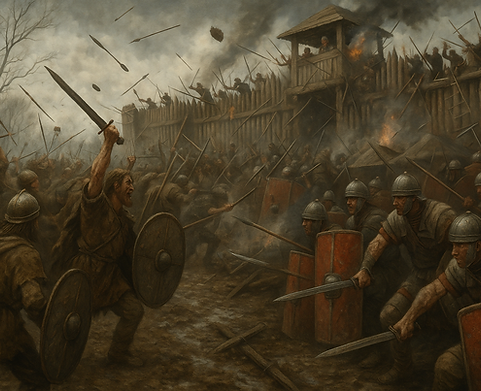
Fifteen days after Quintus and his legion arrived, the Gauls launched a devastating surprise attack. Unlike a mere skirmish, this was a coordinated siege engineered with tactical sophistication. The Nervii and neighboring tribes demonstrated a frightening grasp of Roman siegecraft: they built siege towers, dug mines beneath the Roman fortifications, and erected ramparts—all designed to crush the Roman presence. Caught unprepared, Quintus Cicero’s legion was forced into a desperate defence. Yet, despite the brutal winter conditions and constant missile fire, the Roman soldiers worked tirelessly, reinforcing their defences day and night. Tales of valor quickly emerged: wounded soldiers fought on, and one centurion, his eyes pierced by arrows, refused to yield and continued to rally his men.
As the siege wore on, supplies dwindled and morale began to falter. Quintus attempted repeatedly to send messengers to Caesar for reinforcements, but each envoy was intercepted or killed. With no signs of relief, hope seemed to fade. Then, in an extraordinary turn of events, a Nervian warrior loyal to Rome stepped forward. Disguising himself as a native Gaul, he cleverly hid a message inside the shaft of a javelin and successfully delivered it to Caesar—an act of bravery that likely saved the legion from annihilation.
Upon receiving the urgent message, Caesar wasted no time. Leading two legions, he embarked on a forced march, covering an astonishing sixty miles in a single day through hostile terrain. Along the way, he engaged the enemy at the Battle of the Sabis, decisively defeating the Gauls who sought to block his path. As Caesar neared Quintus’s camp, the sounds of battle—the cries, the smoke—reached his ears. Inside, the Romans were gaunt, wounded, and weather-beaten, but their spirit remained unbroken. The arrival of Caesar’s relief forces marked the turning point, breaking the siege and securing the legion’s survival.
The siege had lasted for several grueling weeks, exacting a heavy toll on the Roman defenders. Yet, remarkably, not a single cohort surrendered or defected. Julius Caesar himself praised Quintus Cicero’s leadership and the legion’s steadfastness in his commentaries. Marcus Cicero, writing to his brother afterward, called the ordeal “immortal glory,” a testament to the courage and loyalty displayed in that desperate winter.
Despite this extraordinary episode, Quintus Cicero’s name has largely been overshadowed by that of his more famous brother and Julius Caesar. However, the defense of the Nervii winter camp remains a powerful example of resilience and military leadership in the face of overwhelming odds—an enduring chapter in the tumultuous saga of the Gallic Wars.
Quick Facts:
-
Date: Winter, 54 BCE
-
Location: Nervii territory (modern-day Belgium)
-
Duration of Siege: Approximately 2–3 weeks
-
Defenders: 1 Roman legion (~5,000 men), led by Quintus Cicero
-
Attackers: Nervii and allies, possibly 60,000 strong
-
Outcome: Siege lifted by Julius Caesar’s relief force
-
Primary Sources: Julius Caesar’s Commentarii de Bello Gallico, Book 5