

The Battle of Teutoburg Forest: The Roman Empire's Greatest Defeat
In 9 CE, deep within the dark and misty Teutoburg Forest, the mighty Roman legions faced one of the most shocking defeats in ancient history. The Battle of Teutoburg Forest wasn’t just a military disaster—it was a turning point that forever halted Rome’s expansion into Germania and reshaped the map of Europe. Under Emperor Augustus, the Roman Empire sought to extend its borders beyond the Rhine River and bring the wild lands of Germania under Roman control. The plan seemed unstoppable. Roman roads, forts, and
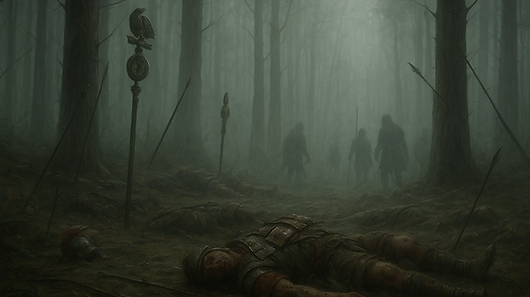
garrisons spread across the region, and local chieftains were drawn into alliances—or so Rome thought.
The Deception of Arminius
Among these allies was Arminius, a Germanic chieftain of the Cherusci tribe who had served as a Roman officer. Trained in Roman military tactics and fluent in Latin, Arminius earned the trust of Publius Quinctilius Varus, the Roman governor of Germania. But behind that trust lay betrayal. Arminius secretly united several Germanic tribes and plotted to lure Varus and his legions into a deadly trap. Responding to a supposed tribal uprising, Varus led three Roman legions—the 17th, 18th, and 19th—into the dense Teutoburg Forest. The march was long, the weather harsh, and the terrain unfamiliar. When the column stretched thin through the woods, Arminius and his warriors struck. Over three brutal days, the Germanic tribes ambushed the Romans from all sides. The legions, unable to form proper battle lines, were cut down in chaos and confusion. Varus took his own life as defeat became certain. The Roman army was annihilated—its eagles captured, its soldiers slaughtered, and its honor shattered.
The Aftermath: A Shattered Empire
When news of the Battle of Teutoburg Forest reached Rome, Emperor Augustus was devastated. Ancient historians record that he cried out, “Quinctilius Varus, give me back my legions!” The 17th, 18th, and 19th Legions were never re-formed, a symbol of the magnitude of Rome’s loss. Rome withdrew its frontier to the Rhine River, abandoning its ambitions to conquer Germania. For the Germanic tribes, the victory at Teutoburg became a defining moment of unity and resistance. For Rome, it was a lesson in the dangers of overconfidence and the power of local knowledge and terrain. The Battle of Teutoburg Forest stands as one of the most significant battles in ancient history. It stopped the Roman Empire’s northern expansion, preserved the independence of the Germanic peoples, and influenced the cultural boundaries of Europe that would persist for centuries. Even today, the battlefield near modern-day Kalkriese in Germany continues to yield artifacts—silent reminders of the day when the legions of Rome met their fate in the shadowed woods of Teutoburg.